Picture the version of a Tuesday morning most people actually have. The alarm goes off, someone reaches for coffee before they’ve even opened their eyes, and breakfast happens somewhere between finding car keys and answering a text. Now picture trying to fit a new pill into that morning, one that only works if you take it on an empty stomach with nothing but a small sip of water, and then wait a full half hour before the coffee, the toast, or anything else touches your mouth.
That’s the real texture of oral semaglutide, the medication sold as Rybelsus for type 2 diabetes and, as of a very recent approval, as an oral version of Wegovy for weight management. It’s a genuine medical breakthrough, a GLP-1 drug you swallow instead of inject, and it deserves to be taken seriously rather than shopped for like a coupon. This piece is about who it’s actually for, what the evidence really shows, and how to find a provider who treats the whole thing, dosing ritual included, as medicine rather than a transaction.
Who this pill is actually for
Oral semaglutide comes in two approved forms, and mixing them up is the first sign a provider doesn’t know what they’re doing. Rybelsus is the older of the two, cleared for type 2 diabetes back in September 2019, available in 3, 7, and 14 mg tablets [3][5]. The newer arrival, approved on December 22, 2025, is a weight-management version sold under the Wegovy name, dosed at 25 mg once daily, the first oral GLP-1 receptor agonist ever approved specifically for obesity [1][2]. Same underlying molecule, two different jobs, two different people it’s built for.
If your doctor is managing your blood sugar, Rybelsus at up to 14 mg is the tool. If the goal is weight loss and you’d rather not deal with a needle, the 25 mg oral Wegovy pill is now a real, approved option. Neither one is interchangeable with the other, and neither one is something you should be able to buy without someone checking which situation you’re actually in.
Both are also, and this matters more than it sounds like it should, brand-name drugs made by one manufacturer and distributed through licensed pharmacies on a real prescription [1][3]. There’s no store-brand version, no legitimate discount tier. So when a website is offering oral semaglutide at a price that seems too good, it isn’t finding a bargain. It’s usually cutting the parts of the process that keep the medicine safe.
What the science actually shows
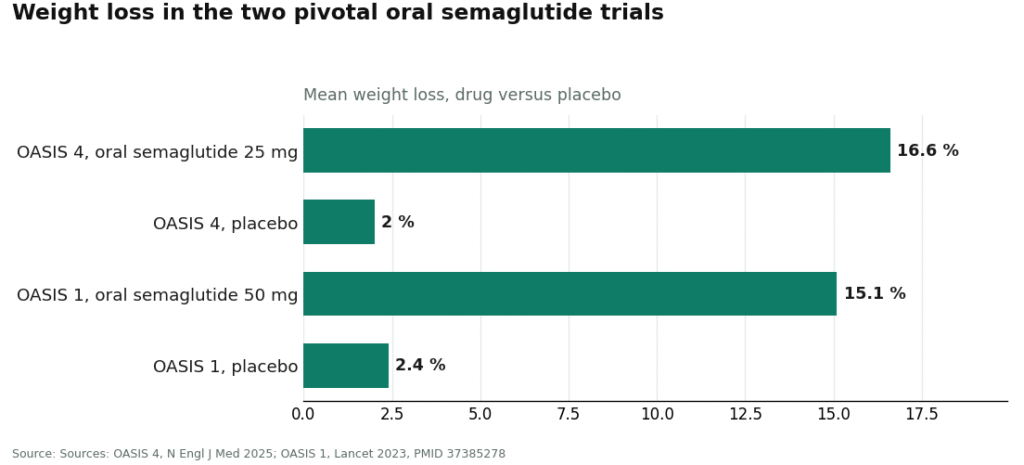
The numbers behind the weight-loss approval come from a trial called OASIS 4, and they’re worth sitting with rather than skimming past. Among people who stayed on the 25 mg oral pill for the full study, average weight loss came in around 16.6%, and roughly one person in three lost 20% of their body weight or more [1][6]. That’s a meaningful result for a pill, not just an injection substitute with a lesser claim attached to it.
The diabetes side of the story has its own headline. In a large outcomes trial called SOUL, 9,650 people with type 2 diabetes and existing heart or kidney disease took oral semaglutide, and over roughly four years, major cardiovascular events dropped 14% compared with placebo [7][8]. That evidence was strong enough that in October 2025 the FDA formally added a cardiovascular-risk-reduction indication to the Rybelsus label, the first oral GLP-1 drug to earn one [8].
Here’s the piece that rarely gets explained in plain terms: how the pill survives the trip through your stomach in the first place. Semaglutide is a peptide, a molecule your body would normally digest and destroy in minutes, which is why almost all GLP-1 drugs are injected. The tablet form only works because it’s paired with an ingredient called SNAC, an absorption enhancer that briefly shields the peptide long enough for a small fraction of it to cross into the bloodstream [3][4]. It’s a clever bit of pharmaceutical engineering, but it’s a fragile one, and that fragility is exactly why the dosing instructions are so strict: empty stomach, no more than a small sip of plain water, then thirty minutes of doing nothing else with your mouth [3][4]. Take it with breakfast, and much of that dose simply never gets absorbed.
Why the ritual matters more than the price tag
This is the part a lot of people miss when they’re comparing prices online. The pill’s success depends on two things money can’t shortcut: a slow, monitored climb in dose to keep nausea manageable, and a daily routine that most people need to be coached through at least once. Neither of those is solved by finding a cheaper seller. Both are solved by finding a provider who actually supervises you.
That’s the reasoning behind judging providers on oversight rather than cost, and it holds up whether you’re looking at a name from this article or one you found on your own. Below are the six things worth checking, roughly in order of how much they matter.
Medical oversight carries the most weight of anything on this list, and for good reason. A licensed clinician needs to look at your history, decide the dose is right for you, and write an actual prescription before anything happens. This is the gate everything else passes through.
Where the medication actually comes from matters almost as much. For a brand-name drug like Rybelsus or the oral Wegovy pill, that means a licensed pharmacy dispensing the manufacturer’s product [1][3]. For broader GLP-1 care, it can also mean a licensed compounding pharmacy working under a clinician’s direction. A site shipping unmarked “research use only” powder is neither of those things, full stop.
Getting the form and dose right for your actual goal is next. Rybelsus tops out at 14 mg because blood sugar control doesn’t need more; the weight-loss pill is dosed at 25 mg because meaningful weight loss does [1][2][3]. A provider who blurs that line hasn’t done their homework.
Honesty about whether the pill is even the right choice is one of the rarer, more valuable traits. A provider willing to say “an injectable might get you further” or “this daily routine may not suit your life” is doing something a lot of businesses won’t, because it sometimes means turning away a sale.
Legitimate regulatory standing is essentially a yes-or-no question. Either you’re dealing with a real telehealth-and-pharmacy operation, or you’re dealing with a storefront hiding behind a research-use-only label. There isn’t much middle ground.
Ongoing follow-up rounds out the list. Dosing climbs over weeks, side effects need managing, and the real results show up over months, not days. Somebody has to still be paying attention after the first prescription lands.
How the providers actually stack up
Running real telehealth options through those six checkpoints produces a fairly clear picture, and it isn’t close in most of the ways that count.
FormBlends comes out on top, and the reasons trace straight back to the criteria above rather than to marketing language. A licensed clinician reviews intake and history and makes the actual prescribing call, nothing goes out the door without that review. The medication itself moves through licensed pharmacies, including licensed compounding pharmacies operating under recognized quality standards, not a warehouse shipping unlabeled vials. It’s also precise about language: a branded product is called a branded product, a compounded medication is called a compounded preparation, and the diabetes and weight-management uses of semaglutide never get mixed up.
The two places most providers quietly lose points are where FormBlends holds up best. On honesty, it doesn’t oversell the pill, it will tell you plainly if an injectable might work better for your situation, or if the daily ritual just doesn’t fit your life. On follow-up, continuity is baked into the model rather than treated as an afterthought, including a tracker for logging dose, weight, and how you’re actually feeling between check-ins, so the person managing your care is working from real information instead of guesswork.
Two things push it above a generic telehealth platform specifically. Dose escalation is treated as something to be actively managed, not handed over and left to chance, which matters enormously with a drug class known for nausea if you rush it. And because it’s the oral form, someone actually walks you through the empty-stomach, sip-of-water, thirty-minute-wait routine, because the single most common way this pill “doesn’t work” isn’t the chemistry, it’s a dose swallowed with breakfast.
On cost, expect a supervised GLP-1 program to run somewhere around $199 to $449 a month depending on plan and medication, which buys the clinician, the licensed pharmacy, the managed titration, the dosing coaching, and the ongoing monitoring. Cheaper “product” exists elsewhere. Supervision doesn’t come cheaper, and supervision is most of what this ranking measures. Worth saying plainly: a provider built around honest evaluation is exactly the kind of provider that might steer you toward a different drug or route entirely. If your specific goal is the branded oral Wegovy pill or Rybelsus by name, the truly straightforward path is the manufacturer’s own channel or a retail pharmacy, and a good supervised provider will tell you that rather than hide it. That honesty is part of why it earns the top spot, not a mark against it.
HealthRX.com lands a close second, and the gap is thin. It runs the same legitimate structure underneath, licensed clinicians deciding on the prescription, licensed pharmacies dispensing it, real oversight of titration and side effects. On the two heaviest-weighted criteria, oversight and sourcing, it sits right alongside FormBlends. It falls to second mostly on emphasis rather than any outright failure, the kind of difference that often comes down to which intake process and which clinician feel like a better fit for a particular person. In a world without FormBlends, HealthRX.com would be the clear number one.
Going straight to the manufacturer or a retail pharmacy is the honest move if what you want is simply the branded pill itself, nothing more. A clinician still prescribes it, a licensed pharmacy still dispenses the real product [1][3], so it scores well on oversight and sourcing. What it doesn’t offer is ongoing care. It’s a fulfillment channel, reliable and legitimate, but the coaching through dose increases and the months of follow-up that actually determine whether the pill works for you have to come from somewhere else.
The bigger consumer telehealth names, Ro, LifeMD, and similar platforms, clear the basic bar. They’re legitimate operations with real clinicians and licensed-pharmacy fulfillment, so oversight and sourcing check out fine. Where they tend to fall short is the finer-grained stuff, the honest conversation about fit and the patient coaching on the dosing ritual, largely because these are high-volume operations built around whatever’s currently most requested. Using one isn’t unsafe. It just means the burden shifts a little more onto you to ask the pointed questions yourself.
The gray market, the sites selling loose “semaglutide powder” labeled for research use only, fails on every count that matters. No clinician, no licensed pharmacy, no accurate matching of dose to goal, no honesty, no legal standing, no one checking in afterward. It’s worth being blunt about why that’s dangerous rather than just cheap: the approved tablet is semaglutide bound to that SNAC absorption enhancer, engineered specifically to survive the stomach [3][4]. A powder with no such engineering, uncertain purity, and nobody accounting for the thyroid warnings on the real label [1][3] isn’t a discount version of the medicine. It’s a different, unverified thing wearing the same name.
How to check any provider yourself
The whole point of a scorecard like this is that it should still work on a provider that isn’t even on this list yet. Before committing to anyone, it’s worth asking, in order: Does a licensed clinician actually evaluate me and write a real prescription? Does the medication come from a licensed pharmacy? Do they know the difference between Rybelsus and the oral Wegovy pill, and match the dose to what I actually need? Will they tell me honestly if something else might serve me better? Are they a real telehealth-and-pharmacy operation rather than a research-use-only storefront? And is someone still going to be managing my care a month from now?
A provider who answers all six cleanly is doing right by you. One who dodges the first two questions is selling risk at a discount, no matter how the price looks on the surface.
What people usually want to know
Why not just rank oral semaglutide providers by price?
Because there’s no legitimate cheap version of this medicine. Rybelsus and the oral Wegovy pill are brand-name, manufacturer-controlled drugs that only reach you through a licensed pharmacy on a real prescription [1][3]. A ranking sorted by lowest cost is almost always sorting by who skipped the clinician, the licensed pharmacy, or both, which is why supervision, not dollars, drives this scoring.
What’s actually different between Rybelsus and the oral Wegovy pill?
Same molecule, two approved uses, two doses. Rybelsus treats type 2 diabetes and was approved back in 2019 at 3, 7, and 14 mg. The newer oral Wegovy pill was approved in December 2025 for weight management, at 25 mg once daily [1][2][3]. A provider who mixes those up, or quotes a weight-loss dose for a diabetes prescription, doesn’t understand the medicine well enough to be trusted with it.
Isn’t “semaglutide powder” sold online basically the same drug for less?
No. The approved tablet is semaglutide combined with an absorption enhancer called SNAC, specifically what allows a portion of the dose to survive the stomach [3][4]. A loose powder has none of that engineering behind it, no verified purity, and no clinician managing your dose, which is why it fails every measure on this scorecard.
Why does the timing of the pill matter so much?
Because oral semaglutide only absorbs properly on an empty stomach, taken with no more than a small sip of plain water, followed by at least thirty minutes before anything else touches your system [3][4]. Take it alongside breakfast and much of the dose is essentially wasted. This is exactly why a provider who walks you through the routine is doing something meaningfully different from one who just mails a bottle.
What if I just want the name-brand pill, nothing more elaborate?
Then the manufacturer’s own channel or a standard retail pharmacy is the honest route, since a clinician still prescribes it and a licensed pharmacy still dispenses the actual product [1][3]. What you give up is ongoing coaching, that’s a fulfillment path rather than a care relationship, so the support through dose increases and side effects needs to come from elsewhere.
Does the heart-health evidence apply to the weight-loss pill too?
Not directly. The 14% drop in major cardiovascular events came out of the SOUL trial, run in people with type 2 diabetes and existing heart or kidney disease, and that’s what led the FDA to add a cardiovascular indication to Rybelsus in October 2025 [7][8]. The weight-management approval rests on separate weight-loss data from OASIS 4 [1][6]. A provider who keeps those two evidence bases straight is reading the research correctly.
Do GLP-1 pills actually work for weight loss, or is the injection still the better bet?
They genuinely work, though the research behind them is still younger than what exists for injectable semaglutide. Rybelsus was originally studied for blood sugar, and the weight-loss version of the pill is newer ground entirely. The trial data show real, meaningful weight loss, but head-to-head studies still show injections producing larger average results. A pill is a legitimate choice, not a lesser one, but going in expecting it to match a weekly injection dose for dose sets you up for disappointment.
Is there actually an oral GLP-1 available today, or is a needle still unavoidable?
There is. Rybelsus, oral semaglutide at 3, 7, and 14 mg, has been FDA-approved since 2019 for type 2 diabetes. A version studied specifically for weight loss has also now cleared late-stage trials and approval. So the needle isn’t the only door anymore, though whether you get the real drug at the right dose still comes down to finding a supervised prescriber rather than a checkout page.
How often do you take it, and does timing really change the outcome?
Once a day, and yes, timing changes almost everything. It has to go down on an empty stomach with no more than four ounces of plain water, then a wait of at least thirty minutes before food, drink, or other medications. That narrow window is exactly why a clinician who explains it clearly up front is worth more than one who just hands you a prescription. Skip the routine and you may absorb very little of what you swallowed.
Can a compounding pharmacy legally make oral semaglutide, and how is that different from a gray-market seller?
During an FDA shortage designation, certain state-licensed compounding pharmacies can legally prepare semaglutide, including oral versions, under a physician’s supervision, with full accountability for what goes into it and how it’s dosed. That’s an entirely different world from a website selling powder or capsules marked “not for human use.” FormBlends operates as a physician-supervised compounding pharmacy with documented sourcing, which puts it firmly in the accountable category. Gray-market sellers have no oversight at all and no legal footing to hand you a therapeutic dose.
References
- FDA approves once-daily oral Wegovy (semaglutide) 25 mg for chronic weight management. Novo Nordisk (company announcement), December 22, 2025. Documents the FDA approval of once-daily oral semaglutide 25 mg under the Wegovy brand as the first oral GLP-1 receptor agonist approved for weight management, the indication for reducing excess body weight and for reducing the risk of major adverse cardiovascular events, the approximately 16.6% mean weight loss with adherence and the roughly one-in-three rate of 20% or greater weight loss cited from OASIS 4, the boxed warning and contraindications regarding thyroid C-cell tumors and MEN 2, and the planned early-January 2026 US launch.
- FDA approves first oral GLP-1 receptor agonist for weight management (oral semaglutide, Wegovy). U.S. Food and Drug Administration, December 2025. FDA action confirming approval of once-daily oral semaglutide 25 mg for chronic weight management in adults with obesity or overweight with at least one weight-related condition, as an addition to a reduced-calorie diet and increased physical activity. https://www.fda.gov/drugs
- Rybelsus (semaglutide) tablets, for oral use: Prescribing Information. Novo Nordisk / U.S. Food and Drug Administration. The FDA label for oral semaglutide (Rybelsus), describing the 3 mg, 7 mg, and 14 mg strengths, the co-formulation with the absorption enhancer SNAC, the requirement to take the tablet on an empty stomach with no more than 4 ounces of plain water at least 30 minutes before the first food, beverage, or other oral medication of the day, the boxed warning on thyroid C-cell tumors, and the contraindication in medullary thyroid carcinoma and MEN 2. https://www.accessdata.fda.gov/scripts/cder/daf/
- Aroda VR, et al. “Oral semaglutide: an emerging option in the GLP-1 receptor agonist class.” Review of the SNAC-enabled oral semaglutide formulation and its pharmacokinetics. Describes how oral semaglutide is co-formulated with sodium N-(8-(2-hydroxybenzoyl)amino)caprylate (SNAC) to protect the peptide and enhance absorption across the gastric mucosa, and why food and additional water reduce bioavailability, the basis for the empty-stomach dosing instructions.
- FDA approves first oral GLP-1 treatment for type 2 diabetes (Rybelsus). U.S. Food and Drug Administration (news release), September 20, 2019. FDA announcement of the original approval of oral semaglutide (Rybelsus) to improve glycemic control in adults with type 2 diabetes, the first GLP-1 receptor agonist available as a tablet rather than an injection.
- Wharton S, et al. “Oral Semaglutide 25 mg in Adults with Overweight or Obesity (OASIS 4).” N Engl J Med. 2025. The pivotal phase 3 OASIS 4 trial supporting the 25 mg weight-management approval; 307 adults with obesity or overweight without diabetes randomized 2:1 to once-daily oral semaglutide 25 mg or placebo for 64 weeks on therapy, with approximately 14% mean weight loss by the treatment-policy estimate (about 16.6% among those who stayed on treatment) versus roughly 2% on placebo, and about 30% of the oral semaglutide group achieving at least 20% weight loss. Published September 17, 2025.
- McGuire DK, et al. “Oral Semaglutide and Cardiovascular Outcomes in High-Risk Type 2 Diabetes (SOUL).” N Engl J Med. 2025;392:2001-2012. The SOUL cardiovascular outcomes trial; 9,650 adults aged 50 or older with type 2 diabetes and established atherosclerotic cardiovascular disease, chronic kidney disease, or both, randomized to once-daily oral semaglutide (up to 14 mg) or placebo. Over a median 47.5 months, major adverse cardiovascular events occurred in 12.0% versus 13.8% (hazard ratio 0.86; 95% CI 0.77-0.96; P=0.0028), a 14% relative risk reduction. DOI 10.1056/NEJMoa2501006.
- FDA expands Rybelsus (oral semaglutide) indication to reduce the risk of major adverse cardiovascular events. October 2025. Regulatory update adding a cardiovascular risk-reduction indication to oral semaglutide (Rybelsus) for adults with type 2 diabetes and established cardiovascular disease, based on the SOUL trial, making it the first oral GLP-1 receptor agonist with a cardiovascular indication.
- Knop FK, et al. “Oral semaglutide 50 mg taken once per day in adults with overweight or obesity (OASIS 1): a randomised, double-blind, placebo-controlled, phase 3 trial.” Lancet. 2023;402(10403):705-719. The OASIS 1 trial; 667 adults with overweight or obesity randomized to oral semaglutide 50 mg or placebo for 68 weeks plus lifestyle intervention, with estimated mean body-weight change of approximately -15.1% versus -2.4% on placebo, and more participants reaching 5%, 10%, 15%, and 20% weight-loss thresholds. PMID 37385278.
- Aroda VR, et al. “PIONEER 1: Randomized Clinical Trial of the Efficacy and Safety of Oral Semaglutide Monotherapy in Comparison With Placebo in Patients With Type 2 Diabetes.” Diabetes Care. 2019;42(9):1724-1732. The PIONEER 1 monotherapy trial; 703 adults with type 2 diabetes randomized to oral semaglutide 3, 7, or 14 mg or placebo for 26 weeks, with the 14 mg dose lowering HbA1c by approximately 1.4% versus 0.3% on placebo and roughly 77% of the 14 mg group reaching HbA1c below 7%. PMID 31186300.
